Overweight Dogs: How to Spot It (BCS) and Help Your Dog Lose Weight Safely
How to use body condition score (BCS) to spot overweight in dogs, why it shortens lifespan, and how to calculate a safe weight-loss diet and pace without the yo-yo effect.
Published 2 September 2026 · 10 min read
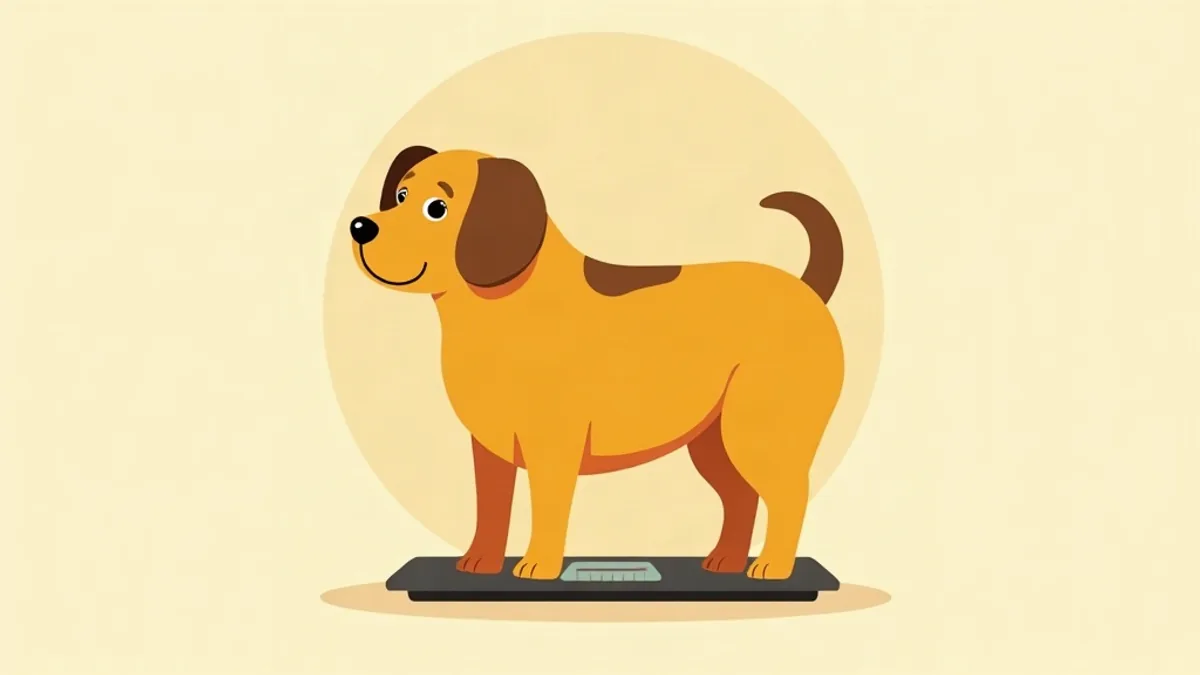
Overweight is so common in dogs that owners often don’t notice it, because “a bit chunky” looks like the normal state. Repeated body-condition surveys at vet clinics and dog shows consistently find that somewhere between a third and half of pet dogs are overweight or obese. The gap between a lean dog and an obese one, the data suggests, is measured in years of life gained or lost. This article covers how to measure a dog’s condition objectively, what it should weigh, and how to help it lose weight safely, without the yo-yo effect.
Why weight matters more than it seems
The most frequently cited evidence comes from a long-term study of Labrador Retrievers (Kealy et al., 2002), in which one group of dogs was fed 25 percent less than the other from puppyhood through their entire lives. The dogs on the restricted diet lived a median of roughly 1.8 years longer, and signs of aging, including osteoarthritis, appeared later.
Beyond lifespan, extra weight strains the joints and speeds up arthritis, particularly in dogs prone to hip or elbow dysplasia. It raises the risk of diabetes and other metabolic problems, makes heat harder to tolerate because the fat layer acts as insulation, and complicates anaesthesia for surgery and routine procedures, since drug dosing and recovery are less predictable in an obese dog.
In practice, owners often notice these secondary signs before the weight itself: a dog that pants harder on a walk, struggles more in warm weather, gets up more stiffly in the morning, or suddenly refuses to jump into the car. It’s easy to write these off as ageing, but they’re often the first sign that body condition has moved past ideal and the joints and heart are working under unnecessary load.
Body condition score: how to spot overweight
Weight in kilograms alone tells you very little, since ideal weight depends on an individual dog’s build. The standard tool is body condition score (BCS), a nine-point scale assessed by eye and by touch: how easily you can feel the ribs, whether a waist is visible from above, and whether the abdomen tucks up from the side.
| BCS | Description | Ribs and waist | Abdomen from the side |
|---|---|---|---|
| 1-2 | Very thin | Ribs, spine, and pelvic bones visible, no palpable fat, waist sharply tucked | Extreme abdominal tuck |
| 3-4 | Thin | Ribs easily felt under a thin layer of fat, waist clearly visible | Abdomen visibly tucked up |
| 5 | Ideal | Ribs palpable without pressing, not visible, waist visible behind the ribs | Abdomen tucked up, smooth line |
| 6-7 | Overweight | Ribs palpable only with pressure or with difficulty, waist barely visible or gone | Abdomen flat or slightly rounded |
| 8-9 | Obese | Ribs not palpable under a heavy fat layer, fat deposits on the chest and tail base, no waist | Abdomen visibly rounded |
Check condition by running your hand along the ribs with light pressure, the way you’d feel your knuckles through the back of your own hand, the ribs should be just as easy to feel. Then look down at your dog from above, there should be a visible narrowing at the waist behind the ribs. Finally, check from the side that the belly line rises up toward the pelvis behind the ribcage, rather than running flat or sagging.
How much should a dog weigh
BCS also lets you estimate how far over ideal weight a dog is. As a rough rule, each BCS point above 5 represents about 10 to 15 percent excess body weight relative to ideal. A dog at BCS 7 weighs roughly 20 to 30 percent more than it should; at BCS 9, that can reach 40 to 50 percent. A 30 kg (66 lb) dog at BCS 7 should ideally weigh around 23 to 25 kg (51 to 55 lb); a 10 kg (22 lb) Dachshund at the same score should be aiming for roughly 7.7 to 8.3 kg (17 to 18 lb). Our food portions calculator works out the right ration for that estimated ideal weight.
An estimate from BCS is always a rough guide, not a lab value, since a score of 6 versus 7 can look different depending on the owner’s experience. If you’re not sure where your dog sits on the scale, bring in a vet tech or vet for the first assessment. After that, you can repeat the check yourself at home using the same method.
A safe pace for weight loss
The goal is a loss of roughly 1 to 2 percent of body weight per week. Faster reduction raises the risk that a dog loses muscle along with fat and falls short on nutrients; a slower pace is hard to stay motivated about, and in practice the diet tends to fizzle out. Check weight regularly, every one to two weeks, ideally on the same scale and at the same time of day.
How to calculate a weight-loss diet
There are two practical approaches that land in roughly the same place.
Calculating from ideal weight. First work out resting energy requirement (RER) from the estimated ideal weight, using 70 x (ideal weight in kg)^0.75. For weight loss, feed at around 1.0x RER, considerably less than a typical adult dog’s maintenance intake of roughly 1.4 to 1.6x RER. Treat this as a starting estimate, not a final number, and adjust it after 2 to 4 weeks based on actual weight loss.
A simplified approach. If you don’t know the exact ideal weight, cut current intake by 20 percent from whatever amount has been maintaining the dog at its current, excess weight. It’s a rougher estimate, but a reasonable starting point until the first check-in weigh-in.
Both approaches need ongoing recalculation: as a dog loses weight, its energy expenditure drops too, so a ration that worked in month one eventually stops delivering the same pace of loss.
Weight-management food, or just less of the same
Weight-management (light) foods carry more protein and fibre per calorie than a regular food, and less fat. That has two effects: a dog on fewer calories still gets enough protein to maintain muscle, and feels fuller thanks to the volume and fibre.
Simply cutting back a regular maintenance food only works up to a point. Reduce the ration by more than roughly 20 percent and the dog loses a proportional share of protein, vitamins, and minerals along with the calories, since the food was formulated for the full amount. For mild overweight (BCS 6), a smaller portion of regular food plus more exercise is usually enough; for more significant obesity (BCS 8 to 9), switching to a weight-management food with higher nutrient density per calorie is the safer route.
Treats, exercise, and getting the whole household on board
Treats count toward the day’s total calorie budget, not on top of it. A sensible ceiling is 10 percent of daily calories, less for a dog actively losing weight, and it’s better to subtract them from the main ration than add them on top. Swap calorie-dense treats for a piece of carrot, cucumber, or a set-aside portion of kibble used for training.
Exercise alone won’t shift weight quickly, dogs burn less during a walk than owners tend to assume, but it helps preserve muscle mass during weight loss and speeds up metabolism over the longer term. Consistency matters most: several shorter walks through the day work better than one long one at the weekend. For dogs with sore joints, start with slower walks and swimming, which doesn’t load the joints, and build up intensity gradually as weight comes down.
Weigh the daily ration on a kitchen scale, not with a scoop. Scoops vary in volume and packing density between brands, so the “same” scoop can mean a difference of tens of grams between two different foods, which matters on a weight-loss diet. Splitting the daily ration into three or four smaller meals also helps a dog feel fuller and cuts down on begging between meals.
The most common reason a diet fails is inconsistency within the household: one family member sticks to the reduced ration, another quietly slips the dog something extra. Without the whole household agreed on what the dog gets and how much, a weight-loss plan tends to fail no matter how well it’s calculated.
Plateaus, and what to do when weight loss stalls
A stall after initial progress is common and usually comes down to one of two causes: either the dog’s energy expenditure has dropped along with its weight and the ration needs recalculating, or extra calories, treats, chew items, or food from another family member, have crept back in. Check actual intake over the last 1 to 2 weeks before adjusting the ration.
When to involve a vet
If a dog isn’t losing weight on a genuine diet and reasonable exercise, or is gaining despite eating less than before, it’s worth investigating hormonal causes. An underactive thyroid (hypothyroidism) slows metabolism and often comes with a thinner coat and fatigue. Cushing’s syndrome (excess cortisol) causes weight gain along with increased thirst, urination, and a distended abdomen. Both are confirmed with blood tests, and without treating the underlying condition, diet alone usually won’t resolve the weight problem.
A vet is worth involving early, too, especially for breeds with a strong tendency toward overweight, such as the Labrador Retriever, Dachshund, or Beagle. For these breeds, it’s worth checking BCS regularly and proactively, not just once the extra weight becomes obvious.
Body condition score
How to tell your dog is the right weight
The number on the scale is not enough, because the ideal weight varies by several kilos within one breed. Looking at your dog from above and feeling the ribs tells you more.
Too thin
BCS 1–3
- Ribs, spine and hip bones visible from a distance
- Sharp waist, tucked belly
- No fat cover and reduced muscle
Raise the portion by 10 % and ask your vet to rule out parasites or another cause.
Ideal
BCS 4–5
- Ribs easy to feel under a thin layer of fat
- Clear waist when seen from above
- Slight tuck of the belly from the side
Keep the portion and weigh every two to four weeks.
Overweight
BCS 6–9
- Ribs hard to feel through the fat, or not at all
- Waist gone, body oval from above
- Fat over the back and at the base of the tail
Cut the portion by 20 % and aim for 1 to 2 % of body weight lost per week.
The nine point scale is the standard vets work with and the one used in the WSAVA guidelines. Each point above five means roughly 10 to 15 % over the ideal weight.
Common questions
How fast should a dog lose weight for it to be safe?
A safe pace is roughly 1 to 2 percent of body weight per week. For a 20 kg (44 lb) dog, that's 200 to 400 g a week. Faster loss raises the risk of losing muscle instead of fat, and of nutrient shortfalls, while a slower pace tends to stall out before showing a visible result and owners give up early. Weigh on the same scale, under the same conditions, every 1 to 2 weeks.
Can I just feed less of my dog's usual food?
In the short term, yes, but for a bigger reduction it carries risk. Cut a regular maintenance food by more than about 20 percent and your dog gets proportionally less protein, vitamins, and minerals along with the calories, since the food was formulated for the full ration. The fix is either a weight-management food with a higher nutrient density per calorie, or a more modest cut combined with swapping part of the ration for low-calorie vegetables.
Why isn't my dog losing weight even on less food?
The most common cause is underestimated treats and extra food from other people in the household that never gets counted in the ration. Another is that energy expenditure drops as weight comes off, so a ration that worked at the start eventually stops being enough and needs recalculating. If diet and exercise keep failing despite genuine effort, it's also worth having the thyroid checked.
Do I really need weight-management food, or can I just feed less of a normal one?
Weight-management foods aren't just marketing, they genuinely have a different nutrient ratio: more protein and fibre per calorie, less fat. That way a dog gets enough protein to maintain muscle even on fewer calories, and feels fuller from the volume and fibre. For mild overweight, cutting back a normal food can be enough; for more significant obesity, a weight-management food is the safer choice.
Can illness cause a dog to be overweight, not just food?
Yes, though it's a minority of cases. An underactive thyroid (hypothyroidism) and Cushing's syndrome are hormonal conditions that lead to weight gain even with sensible feeding. It's worth considering these causes if a dog isn't losing weight despite a genuine diet and exercise plan, especially alongside a thinning coat, lethargy, or increased thirst, and they're something your vet can test for.
Sources
- Kealy R. D. et al. (2002): Effects of diet restriction on life span and age-related changes in dogs. JAVMA.
- WSAVA Global Nutrition Committee: Body Condition Score guidelines
- Association for Pet Obesity Prevention: Body Condition Score charts
Last updated 2 September 2026.