Raw Feeding for Beginners: What BARF Is, the Ratios, and How to Start
A step-by-step guide to the BARF method: the 70/10/5/5/10 ratio, rules for raw meaty bones, hygiene risks, supplements, and who should avoid raw feeding.
Published 2 September 2026 · 10 min read
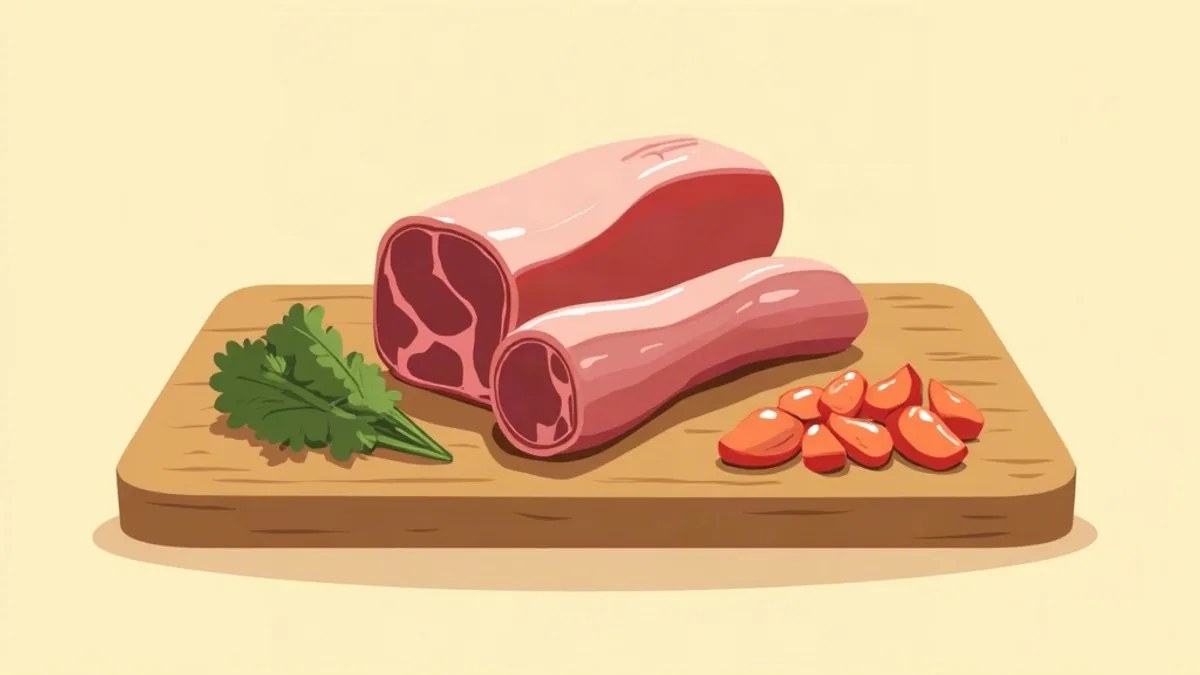
Raw feeding promises something closer to what a dog would eat in the wild. The method works, but only when it’s balanced correctly and the owner understands the risks that come with feeding raw meat. This article is an introduction for anyone considering the switch to BARF for the first time.
What BARF is and where it came from
The term BARF was popularized in the early 1990s by Australian vet Ian Billinghurst in his book Give Your Dog a Bone. It originally stood for Bones and Raw Food; today it’s more often read as Biologically Appropriate Raw Food. The core idea: dogs are genetically very close to wolves, and their digestive system is built for raw animal food, not cooked, processed kibble.
Critics point out that dogs have been domesticated for over ten thousand years and differ from wolves physiologically as well as genetically, including a much better ability to digest starch. In practice, both things seem to hold: a well-formulated BARF diet demonstrably doesn’t harm dogs, and plenty of owners and vets report visible improvements in coat and stool, but “biologically appropriate” doesn’t automatically mean “nutritionally complete with no room for error.”
BARF vs. prey model
The two terms are often confused:
- BARF includes a plant component (vegetables, fruit, sometimes grains or legumes) alongside meat, bone, and organs, plus supplements.
- Prey model drops the plant matter and tries to mirror the tissue makeup of actual prey, typically around 80 percent muscle meat, 10 percent bone, 10 percent organ.
Prey model is conceptually simpler, but without experience it’s easy to fall short on fibre and some of the micronutrients that the plant portion supplies in BARF.
The 70/10/5/5/10 ratio, and why
The most common starting formula for a daily BARF ration is:
| Component | Share | What it includes |
|---|---|---|
| Muscle meat | 70% | Beef, chicken, turkey, lamb, and so on, including meat still attached to bone |
| Raw meaty bones | 10% | Wings, necks, poultry backs, marrow bones for smaller breeds |
| Liver | 5% | A source of vitamin A, copper, and other micronutrients |
| Other organs | 5% | Kidney, spleen, lungs |
| Vegetables and fruit | 10% | Pureed or steamed, a source of fibre and some micronutrients |
Why exactly 5 percent liver
Liver is an extremely concentrated source of vitamin A. Too much vitamin A is toxic to dogs (hypervitaminosis A can damage bones and joints), while too little causes eyesight and skin problems. Around 5 percent of the daily ration is the compromise that covers requirements without risking overdose. More liver isn’t usually needed; less risks a shortfall.
The 70/10/5/5/10 ratio is a starting point for a healthy adult dog, not a fixed rule. For puppies, pregnant or nursing females, seniors, or dogs with health conditions, both the ratio and the components change, and it’s easy to get it wrong without expert guidance.
How much raw food per day
Alongside the ratio of components, the second question is how much a dog should eat in total. The most common rule of thumb is a daily ration of around 2 to 3 percent of body weight for an adult dog with normal activity, rising toward 3 to 4 percent for very active or working dogs, and down to 1.5 to 2 percent for dogs prone to weight gain. Puppies need considerably more relative to their current weight, typically 6 to 10 percent in the first few months, gradually decreasing toward the adult amount by around one year, depending on expected adult size. This is a rough starting estimate to be fine-tuned over time, exactly as with kibble, based on how the dog’s weight and condition develop.
Raw meaty bones: rules you can’t break
Bones are the main natural source of calcium and phosphorus in BARF, but also the riskiest component if two basic rules are broken:
- Never cooked bones. Cooking changes a bone’s structure, making it brittle so it splinters into sharp fragments that can perforate the digestive tract. A raw bone is more pliable and crumbles more safely when chewed.
- Never weight-bearing bones from large animals. Thigh or pelvic bones from cattle are extremely hard and risk cracking teeth. Better choices are meatier bones with more cartilage and a softer structure: chicken and turkey necks, wings, backs, and marrow bones for smaller breeds.
Always size the bone to the dog, so it can’t swallow it whole or hurt itself gulping it down.
Hygiene and the risk of pathogens
Raw meat can carry salmonella, listeria, campylobacter, or pathogenic strains of E. coli. In a healthy adult dog, these bacteria often pass through the digestive tract without symptoms, because a dog’s stomach is considerably more acidic than a human’s. The real risk falls mainly on:
- the dog itself, if it’s a puppy, a senior, or otherwise immune-compromised,
- people in the household who come into contact with contaminated meat, bowls, or dog waste, especially young children, pregnant women, older adults, and anyone immunocompromised.
Freezing doesn’t kill bacteria
An important myth to bust: freezing does not reliably destroy salmonella, listeria, or E. coli, it only halts their multiplication. Once thawed, meat needs the same careful handling as fresh meat. What freezing does handle effectively is some parasites, such as roundworm or tapeworm larvae in fish. That’s why meat for raw feeding, fish in particular, should be frozen solid for several days before serving.
Basic hygiene practice: a dedicated cutting board and utensils for raw meat, thorough handwashing and surface cleaning after prep, keeping meat refrigerated, discarding uneaten portions within 30 to 60 minutes, and disinfecting the bowl regularly.
Pork and Aujeszky’s disease
Raw pork from uncertified sources is a specific risk. It can carry Aujeszky’s disease (pseudorabies), which is almost always fatal in dogs, along with a risk of trichinellosis. Cooking reliably destroys the Aujeszky’s virus; freezing does not. Leave raw pork out of BARF unless it comes from a verified source tested for these risks.
Supplements most BARF diets need
Even a well-formulated BARF ration following the 70/10/5/5/10 ratio usually doesn’t cover everything a dog needs on its own, especially if the meat isn’t from pasture-raised animals. Common additions:
- Omega-3 fatty acids (fish oil), because the omega-6 to omega-3 ratio in typical meat tends to run unbalanced.
- Vitamin E, since fish oil increases the body’s use of antioxidants.
- Iodine, unless the ration regularly includes seaweed or fish.
- Calcium, if bone is left out of the mix (for dogs that can’t tolerate or chew bones); in that case calcium has to come from another form, or the ration ends up significantly short.
Rotating protein sources
Feeding BARF long-term from a single meat source, typically the cheapest available, such as chicken, raises the risk of the same micronutrient gaps recurring, since different meats and organs vary in iron, zinc, copper, and fatty acid content. It’s best to rotate at least two or three types of meat (poultry, beef, lamb, for example) over the course of weeks to months, and to include fish as a genuine omega-3 source, not just rely on the oil supplement.
Who shouldn’t choose BARF
- Puppies without expert guidance. Calcium, phosphorus, and energy requirements during growth, especially for large breeds, are precise, and mistakes show up in the skeleton. Home-formulating BARF for a puppy without input from a nutrition specialist is risky.
- Households with immunocompromised people. Young children, pregnant women, older adults, or anyone post-transplant shouldn’t come into contact with raw meat or its residue.
- Dogs with pancreatitis. BARF tends to be higher in fat than commercial food, and in dogs prone to pancreatic inflammation it can trigger an acute flare-up.
- Dogs with kidney disease. The high protein and phosphorus typical of BARF is contraindicated in renal insufficiency; these dogs need an adjusted diet, usually prescribed by a vet.
Switching to BARF
Make the switch from kibble to raw gradually, ideally over 1 to 2 weeks, and don’t mix raw meat and kibble in the same meal, they digest at different speeds, and combining them raises the risk of digestive upset. It’s more practical to alternate whole meals, kibble in the morning, raw in the evening, gradually shifting the balance toward raw.
Cost and time, honestly
BARF isn’t the cheaper option, even though it can look that way given the lower price of meat per kilogram compared with finished kibble. Real costs climb once you factor in freezer space, the time spent planning a balanced ratio, shopping and prep, and supplements. For a large dog, budget for considerably more time than pouring kibble from a bag.
Commercial raw as a middle ground
Anyone who wants the benefits of raw feeding without the risk of getting the ratio wrong at home can turn to ready-made frozen complete raw diets from pet food manufacturers. These come with the ratio of meat, bone, organ, and supplements already worked out to nutritional standards, removing the risk of a home-formulation mistake. The trade-off is a higher price than buying meat separately, and less control over the exact source of ingredients.
Our raw feeding calculator works out the right daily amount for your dog’s weight and activity level. Before you start, it’s worth reading up on the risks of raw meat specifically, and on feeding chicken bones.
Common questions
What does BARF stand for?
Most often it's read as Biologically Appropriate Raw Food. Originally, when Australian vet Ian Billinghurst popularized the concept in the early 1990s, it stood for Bones and Raw Food. Both versions describe the same feeding method built around raw muscle meat, bones, organs, and a smaller portion of plant matter.
What's the difference between BARF and prey model raw feeding?
BARF includes a plant component alongside meat, bone, and organs, typically 5 to 10 percent vegetables and fruit, plus supplements like fish oil or vitamin E. Prey model drops the plant matter entirely and tries to mirror the tissue makeup of actual prey, roughly 80 percent muscle meat, 10 percent bone, and 10 percent organ. Prey model is harder to balance correctly without experience, especially for fibre and certain micronutrients.
Does freezing kill bacteria in raw meat?
No. Freezing doesn't reliably kill bacteria such as salmonella, listeria, or E. coli, it only slows or stops them multiplying. Once thawed, the meat behaves, and must be handled, essentially the same as fresh meat. Freezing does reliably kill some parasites, such as roundworm or tapeworm larvae in fish, which is why meat intended for raw feeding, fish especially, should be frozen solid for several days first.
Is BARF suitable for a puppy?
Balancing a raw diet for a growing puppy, especially of a large or giant breed, is far harder than for an adult dog because of the precise calcium, phosphorus, and ratio requirements during skeletal growth. Home-formulated BARF for puppies carries a real risk of skeletal development problems without guidance from a veterinary nutrition specialist. If you want to raw feed a puppy, either get expert input or use a quality commercial complete raw diet made for growth.
Can I feed my dog raw pork?
Raw pork from uncertified sources is generally discouraged in raw feeding because of the risk of Aujeszky's disease (pseudorabies), which is almost always fatal in dogs, as well as trichinellosis. Aujeszky's disease is destroyed by cooking but not by freezing, which makes raw pork riskier than raw beef, chicken, or turkey from the same source.
Sources
- FEDIAF Nutritional Guidelines
- WSAVA Global Nutrition Guidelines
- Billinghurst I. (1993): Give Your Dog a Bone
Last updated 2 September 2026.